

How To Set Up A Tig Welder
GUIDE TO TIG WELDING
This is a guide on how to exercise TIG welding using a TIG welder (Tungsten Inert Gas) it aslo includes how to TIG weld videos
TIG welding is a skill that needs to be developed over fourth dimension, with a piece of metal in front of you and with a welding torch in your hands. TIG welding requires patience and practise.
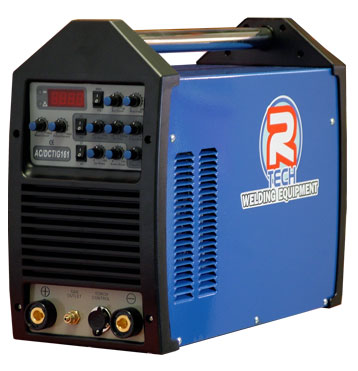
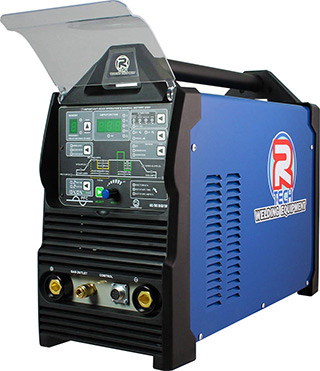
The R-Tech Tig201 Analgoue Ac/DC TIG Welder used in this guide and our TIG EXT Digital Air conditioning/DC Tig Welder
1. WHAT IS TIG WELDING?
-
TIG Welding tin be used to weld aluminium, copper, titanium etc… and even two dissimilar metals. This procedure is ideally suited to treatment tricky welds such every bit S-Shapes, curves, corners or where the weld is going to exist visible and where accuracy and finish is important. TIG welding allows a greater variety of metals to be welded than other forms of welding
-
With superior arc and weld pool control, TIG welding allows you to create clean welds when appearances count. Because the heat input is often controlled by pressing on a foot pedal, similar to driving a automobile, TIG welding allows you lot to estrus up or cool down the weld pool giving you precise weld bead control. This makes TIG welding ideal for cosmetic welds like sculptures, architectural and automotive welds
-
The TIG welder generates rut via an arc of electricity jumping from a tungsten metal electrode to the metal surface that you intend to weld – which is usually aluminium or steel
-
TIG stands for Tungsten Inert Gas – named from the tungsten electrode and the shield of inert gas (Argon or argon mixture) surrounding it.
-
A TIG welder needs a filler rod to provide the welding bead when joining ii pieces of metallic together
-
TIG welding produces no sparks or spatter because only the necessary amount of filler metal is added to the welding pool.
-
TIG welding produces no smoke and fumes unless the base metal contains contaminants or has a dirty surface
-
TIG welding doesn't produce slag and requires no flux because the argon gas protects the weld pool from contamination
2. CHOOSING AND PREPARING THE TUNGSTEN ELECTRODE
A tungsten electrode is required when TIG welding and this is inserted into the welding torch. This electrode carries the welding current to the piece of work. For welding aluminium the almost popular choice is a Zirconiated TIG tungsten electrode (White tipped), for steel the most popular is a Thoriated TIG tungsten electrode (Ruddy Tip)
A number of tungsten alloys are besides available (including Thoriated Tungsten)
There are different sizes of tungsten'south available which chronicle to the welding power you are using for a detail job. Information technology is important to use the correct size of electrode for the welding power you are going to apply. Meet below:
| ELECTRODE RATINGS | |||
| Electrode Diameter (mm) | ii% Thoriated on DC (amps) | Pure Tungsten on DC (amps) | Zirconiated Tungsten on AC (amps) |
| 1.0 | fourscore | 30 | 60 |
| 1.six | 150 | 80 | 120 |
| 2.4 | 250 | 130 | 180 |
| 3.2 | 400 | 180 | 250 |
| 4.0 | 500 | 240 | 320 |
| iv.eight | 750 | 300 | 390 |
| vi.4 | 1000 | 400 | 525 |
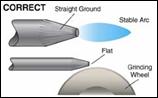
Training of the tungsten electrode is of import. The stop needs to exist ground to a betoken (run into images beneath). Brand new electrodes will ever need to be prepared in this manner. When welding on aluminium the tungsten will begin to course a ball, this is perfectly normal. When welding steel the electrode will e'er stay pointed.
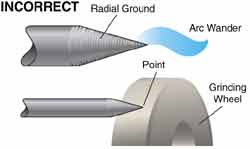
With the introduction of new power source technologies, the use of pure tungsten is decreasing.
Pure tungsten melts at a lower temperature causing it to easily class a rounded ball at the tip. When the brawl grows too large, it interferes with your ability to see the weld puddle and causes the arc to go unstable.
Ceriated tungsten can withstand higher temperatures and works very well with the new squarewave and inverter machines for the post-obit reasons:
-
Holds a betoken longer and starts well at low amperages.
-
Can be used on both Ac and DC polarities. When welding aluminum, it has get very acceptable to grind a point on ceriated tungsten (especially when welding on thinner materials).
-
Allows welding amperages to be increased by 25-30% compared to Pure tungsten of the same bore.
How to Weld Videos If y'all want to see our range of How To TIG Weld Videos, click on link below.
R-Tech TIG Welding Guides - How to TIG Weld Aluminium & Steels with a R-Tech TIG Welder
If yous want to see video on how to fit TIG torch consumables and h2o libation, click on link beneath
R-Tech TIG Welding Guides - How to fit TIG torch consumables and fit water libation
three. SAFTEY GEAR
TIG welding can be a pretty rubber thing to practise so long as you follow a few important safety precautions. TIG welding produces lots of oestrus and lots of harmful lite, you demand to have a few steps to protect yourself.
The light that is generated by any form of arc welding is extremely bright. It volition burn down your eyes and your skin just like the sun will if you don't protect yourself. The first matter you lot will need to weld is a welding helmet. I am wearing an machine-darkening welding helmet below. They are really helpful if you are going to do a lot of welding and brand a great investment if you remember y'all will exist working with metal often. Manual masks require you to wiggle your head dropping the mask into position or crave to use a free hand to pull the mask downwardly. This allows you to use both your easily to weld, and not worry about the mask. Always ensure to protect others from the low-cal likewise and utilise a welding screen to make a edge around yourself. The lite has a tendency to describe on lookers who might need to shielded from being burned too.
Clothing gloves and leathers to protect yourself from molten metal splattering off of your work piece. Some people like sparse tig welding gloves for welding and then you lot can have a lot of control. In TIG welding this is especially true. The leathers will non only protect your skin from the rut produced past welding simply they will besides protect your pare from the UV calorie-free produced by welding. If you are going to be doing whatever corporeality of welding more simply a minute or ii you will want to cover up because UV burns happen fast!
If you are not going to habiliment leathers at least make sure that yous are wearing clothing made from cotton wool. Plastic fibers like polyester and rayon will melt when they come up into contact with molten metal and will burn you. Cotton wool will get a hole in information technology, but at least it won't burn and brand hot metal goop.
Do not wear open toed shoes or synthetic shoes that have mesh over the top of your toes. Hot metal often falls straight down and I have burned many holes through the tops of my shoes. Molten metallic + hot plastic goo from shoes = no fun. Clothing leather shoes or boots if you have them or cover your shoes in something non-combustible to stop this.
Weld in a well ventilated area. Welding produces hazardous fumes which y'all shouldn't exhale in if yous can avoid it. Habiliment either a mask, or a respirator if you lot are going to be welding for a prolonged amount of time.
Fire hazards Molten metal can spit several anxiety from a weld. Grinding sparks are even worse. Any sawdust, paper or plastic bags in the surface area can smolder and catch fire, so keep a tidy expanse for welding. Your attention will exist focused on welding and it can be hard to encounter what'southward going on around you if something catches burn. Reduce the chance of that happening by immigration abroad all flammable objects from your weld area. Keep a fire extinguisher abreast the exit door from your workshop. CO2 is the all-time type for welding. Water extinguishers are not a expert thought in a welding store since you are standing adjacent to a whole lot of electricity.
Important Safety Alert DO Not WELD GALVANIZED STEEL. Galvanized steel contains a zinc blanket that produces carcinogenic and poisonous gas when information technology is burned. Exposure to the stuff can issue in heavy metal poisoning (welding shivers) - influenza like symptoms that tin can persist for a few days, but that can also cause permanent damage.
Gloves, machine-darkening helmet and a suitable cotton based jacket are essential to proceed safe
4. PREPARING FOR THE WELD Earlier you kickoff welding make sure things are properly setup at both the welder and on the piece you are near to weld.
The Welder Getting the correct settings for type of weld you are doing requires some trial and error, specially if you lot are new to using TIG welders. Some basic parameters are consistent to all TIG welding whereas many other functions may only be available on higher specification machines. For welding today we will be using an R-Tech Tig201 Tig Welder which is a fully featured Tig Welder and in the picture below y'all tin can run into the front panel with a description of the controls and what they really practise.
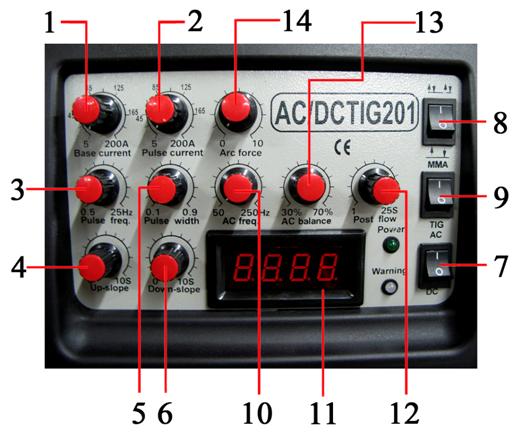
Fig iv
i. Base current command
This adjusts the main welding electric current and is shown in 50.E.D (Fig 4.11)
2. Pulse peak current aligning
This sets pulse amperage and must be set above the base (main) current amperage. If ready to zero pulse welding is disabled.
3. Pulse frequency adjustment
This sets how often pulse will occur 0.5 – 25hz
4. Up slope
Adjustment 0-10 seconds. The master welding electric current raises from minimum amperage to main current selected in fourth dimension selected when weld started
5. Pulse width
Pulse width adjustment – This sets length of pulse 0.1 – 0.ix seconds
6. Down gradient
Down-Slope adjustment 0-10 seconds. The primary welding electric current decreases from main amperage to minimum amperage in time selected when weld finished – Sometimes known as crater fill.
7. Air-conditioning – DC Selector switch
This switch selects either DC for welding steels or Air-conditioning for welding alloys
Practice Non SWITCH WHEN WELDING As Harm TO MACHINE Can OCCUR.
8. 2/4 Style selector switch
ii/4 Step trigger mode switch – TIG welding can either be done in 2 or 4 step manner.
When the trigger mode is in the 2 step position the following sequence will occur
Press and hold the TIG torch switch to start sequence.
The machine will open gas valve to start flow of shield gas, after a 0.5 seconds pre-flow time to purge air from torch hose the welding output of machine will exist turned on and the arc will exist started. After the arc is started the output current will increase from the start (min) current to base of operations (main) electric current in fourth dimension selected by slope-up. Principal power will be achieved instantly if no gradient up is in the '0' minimum position.
Release the TIG torch switch to end sequence.
The machine will now decrease output to finish (min) current in time set by slope-down, once at finish (min) current the machine will stop output and the gas valve will continue to operate for the selected time (post flow)
Possible variations of this standard sequence are shown in diagram below. It is possible to press and concur tig torch switch a second time during downslope time to restart. Subsequently the switch is pressed the output current volition raise to base of operations (chief) current
Press and concur the TIG torch switch to get-go sequence.
The machine will open gas valve to beginning flow of shield gas, after a 0.five seconds pre-period time to purge air from torch hose the welding output of auto will be turned on and the arc will be started. Later the arc is started the output current will be at start (min) current
This status can be maintained as long equally required.
Release the TIG torch switch to go to step 2
The motorcar volition now increase output to base (main) current in time gear up past slope-up.
Press and concur the TIG torch switch when primary weld is complete
The machine volition now decrease the welding output current to finish (min) in down-gradient time set. One time at terminate (min) output you can release the TIG torch switch to finish weld the gas postal service-period volition continue to run for set fourth dimension.
ix. MMA – TIG mode switch
MMA-TIG mode switch. Switches betwixt TIG (GTAW) & MMA STICK (SMAW) welding
10. Air conditioning squarewave frequency adjuster
AC Squarewave frequency adjustment 20-250Hz.
Traditional TIG welders take a fixed frequency of 60Hz, the TIG201 advanced engineering science allows Air-conditioning frequency adjustment from 20-250hz, as you turn up the frequency the width of arc from tungsten decreases allowing more control of weld pool and an increment travel speed
The pitch racket of weld will increment when AC frequency is turned up, this is normal. 100 - 120Hz is the 'sweet spot' for most Ac welding.
11. LED Display
three digit LED meter is used to display the pre-gear up (earlier welding) amperage and bodily amperage (when welding).
12. Gas mail flow aligning
Gas post flow aligning 1 – 25 seconds. The gas keeps flowing after weld has finished, this cools & stops tungsten from getting contaminated.
Annotation: Gas pre-flow time is stock-still at 0.five seconds in TIG mode just no pre-period time will occur if the arc is restarted during post flow time as gas is already flowing.
thirteen. AC squarewave balance (SP%)
SP% AC Squarewave residuum control thirty% – 70% When welding dirty/contaminated material more cleaning may need to exist selected.
Set at 50% this provides balanced command suitable for near AC Welding. 30% is max penetration and seventy% is max cleaning
-
Arc force (Stick – SMAW only)
-
This provides amend arc starting when in MMA stick way, useful when you are welding dirty/rusty material or cold/clammy welding electrodes
The Metal
An earthing clamp should be nowadays and attached to your workpiece or, as in the picture below, the bench. The other stop should be attached to your welding automobile. Some kind of big metallic area is necessary to let electricity flow through your metal. If you don't take a welding demote so a big sail of metal will practise the job. Be sure to securely clamp down the metals you lot are working on
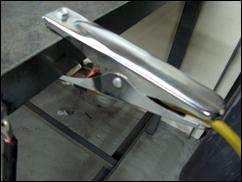
Earth clamp secured to the workpiece or bench
5. GETTING STARTED ON THE WELD
Belongings the torch
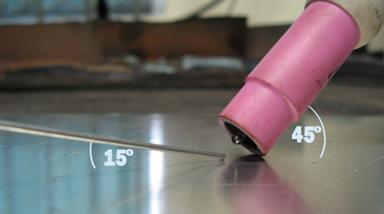
Concord the torch every bit shown in the photograph below. The tungsten should exist raised from the surface of the piece of work by nigh 3-6mm. Do not let the tungsten touch on the work or information technology will contaminate your material and yous volition have to re-grind the tungsten. aim for a working angle of about 45 ? to the work surface.
Catch a filler rod
Take a filler rod in your left hand and position horizontally so that information technology rests at a 15 ? bending to the piece of work, when y'all insert the filler rod into weld puddle, do so by adding it to the edge of the pool keeping it away from the tungsten to avoid tungsten contamination. The filler rod will cook and flow into the weld pool.
Foot Pedal Control
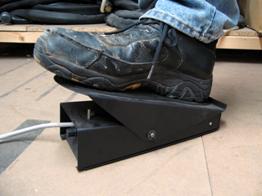
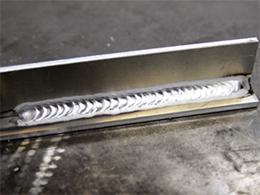
Controlling the weld current is best done by using a remote foot pedal (pictured on the left). Check to see if your machine can run one of these. This kind of control volition help you keep the weld puddle steady and help make sure that the pool doesn't grow, shrink, spread or narrow during the weld. Information technology's a skillful thought to practice controlling the welding amperage with a foot pedal on some scrap before you start welding for existent. The picture on the right shows a good, controlled weld.
6. LETS Practise SOME TIG WELDING!
Establishing the arc with torch switch operation
Gear up the amperage desired on the principal amperage command on motorcar and press the torch switch and the arc will exist started.
Establishing the arc with foot pedal operation
Getting the arc started requires at least a half press of the pes pedal especially if welding at very depression amperages. NOTE: A human foot pedal in functioning volition only allow the maximum amperage that you have attack the automobile to travel to the torch head. If yous feel difficulty starting the arc this is very normally down to an insufficient amperage setting on the welder and non related to the performance of the pes pedal.
Tacking Tack welding two pieces together will hold your work in place and prevent the work from moving as you progress along the weld. Metals similar aluminium spread oestrus very rapidly so work that is non tacked may have a tendency to warp or distort past the time yous reach the end of a section of the weld. Tacking to stop distortion is very important.
Creating a weld puddle
The arc will rapidly build rut into the metal and class a 'pool' of fluid metallic. At this bespeak the filler rod needs to be presented to the edge of the pool. The filler rod will become fluid and class into the weld puddle. If you rut the metal in one place for too long the metal volition warp and deform. (If practicing, effort backing off the pressure on the pes pedal and lowering the amperage to the weld pool to see what happens). Exercise not put the filler rod to shut to the tungsten electrode as it volition contaminate the tungsten and you lot volition have to grind it down and restart, a contaminated tungsten will produce a dirty weld and can exist very hard to offset the arc too.
Creating a bead
In one case a pool is established and the filler rod presented you must move along with the torch – pushing the puddle along the joint and repeating the process of adding in the filler rod as you lot get. This is called 'leading' the electrode
If the metal starts to burn or melt abroad then also much current is being fed to the pool and y'all should elevator off the foot pedal
If the metal gets a flaky but not liquid look to it, put in more power past increasing the pressure level on the foot pedal
7. TYPES OF WELD
The real secret of producing quality TIG welds is mostly in getting the weld pool to form, at the same fourth dimension, on both pieces of metal. The easiest type of weld is the 'fillet', two metals joined at correct angles. See below:
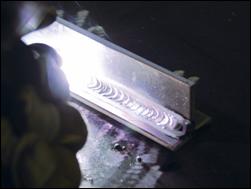
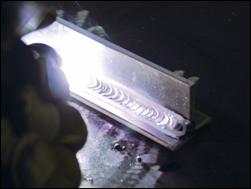
To make a sound weld you must learn to combine all the mechanical techniques into one fluid motility. A good weld should wait like a stack of fish scales lying on top of each other. Practice and so that welding on all joints in all positions becomes 2d nature.
Visually and structurally test your welds on pieces of flake before starting a real piece of work.
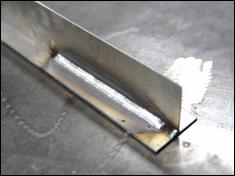
TIG welding aluminum progresses at a faster travel rate than steel. Due to aluminum's loftier thermal conductivity and low melting point, the travel speed volition increase equally the welding progresses. If the travel speed is not increased, at that place is a hazard of excessive melt-through on sparse aluminum parts
Advanced features found on R-Tech TIG Welders
Slope Up (merely used with torch trigger performance)
This enables you lot to set a time that when you start welding the car will outset at minimum amps and slope upwardly to the main amperage you lot have fix on command panel in the time you lot have assault gradient up command.
Slope Down (just used with torch trigger functioning)
This enables you to fix a fourth dimension that that when you lot stop welding the machine will slope down to minimum amps you have set on command panel in the time you take attack slope down control. This is also known as crater fill and allows y'all to have a better end off weld and no crater
Gas post flow aligning This allows you to set the fourth dimension the gas will go along flowing one time the weld is finished, this cools the torch on air cooled torch systems and stops the tungsten from getting contaminated. If the tungsten turns blue on gets pitted after welding, turn the post flow upwards. The dominion of thumb is to gear up the gas post menstruum fourth dimension to 4 x size of tungsten beingness used, I.E 2.4mm tungsten set up post flow to 9-ten seconds. The amperage you are welding at volition likewise affect this, higher amperages need longer post menses time
Ac Remainder control (SP%)
SP% AC Squarewave residual control is adaptable from 30% – seventy%
Prepare at 50% this provides counterbalanced control for Ac Welding. The machine spends l% of wheel in positive way which lifts the oxide surface off the work (power flows from workpiece to tungsten) and 50% in negative mode which penetrates the work (power flows from tungsten to workpiece)
xxx% is maximum penetration, the car is more torch negative - 30% positive / 70% negative.
lxx% is maximum cleaning, the car is more torch positive - 70% positive / 30% negative
With clean metal y'all can select more than penetration and the machine will spend more than time penetrating work (negative part of bicycle).
When welding muddy/contaminated material more cleaning may demand to be selected, the machine will spend more time lifting coating off the piece of work (positive part of bicycle).
For most AC welding we suggest you ready machine to about 40% SP. This means 40% of weld cycle is positive (cleaning) and 60% of weld is negative (penetration)
Tip. If you are welding shut to the tungsten limits, I.E 160amps on a 2.4mm tungsten and the end of tungsten is wobbling and falling off, turning down the SP% volition requite amend tungsten stability as the current is flowing from tungsten giving more than penetration (negative part of cycle - more penetration)
In AC mode if you set machine to 30%, maximum penetration and set the Air conditioning frequency to 150Hz or to a higher place, you tin grind the tungsten tip to a bespeak to give a much narrower arc and the tungsten volition stay sharper for longer.
Air-conditioning Squarewave frequency control
This is merely plant on the very advanced TIG welders and has many benefits On most TIG welders this is fixed at 60Hz – On the Tig201 Tig welder we used above you control the Air-conditioning frequency from xx – 250Hz When turning up the AC frequency y'all have more weld cycles per second and so this gives yous first of all:- A faster travel speed helping you to go on ahead of the heat transfer. The width of the arc from tungsten gets smaller the higher the frequency is set so you lot get pinpoint accuracy and the weld width is much easier to control. When you turn up the Ac frequency the pitch of the weld will increase this is completely normal. Beginners will find welding with a tig welder that has Ac frequency control is a lot easier than using 1 without this feature. Do non confuse AC frequency control with pulse frequency which I will cover next, this is for pulse welding.
Pulse Welding (commonly used on torch trigger operation)
What will happen is the welder will switch between the two amperages and this allows you to limit the corporeality of oestrus going into piece of work, especially good for welding stainless steel, it tin can requite a very small width of weld or limit rut deformation. You can also ready the post-obit: Pulse width – This is how long the pulse will last and on the Tig201 we used above can be prepare between 0.1 to 0.9 seconds Pulse frequency adjustment - This sets how frequently pulse will occur and on the Tig201 can be adjusted between 0.5 – 25hz So turning up the pulse width will brand the pulse terminal longer than the base/main current set and turning up the frequency will mean the pulse amperage will happen more ofttimes. Setting up pulse welding is downward to the individual user and its best to get some scrap and play near with the settings, pulse welding when mastered can actually help with the appearance of finished weld and on this motorcar exist used on both DC and Ac settings.
Pulse welding is not equally complicated and some people think, instead of welding at one amperage for the entire weld y'all can fix two amperage for the motorcar to use I.E Base of operations / Primary amperage 40amps, Pulse amperage 100amps
Remote pes pedal This allows y'all to control the amperage when actually welding which can exist very benign particularly when welding aluminium. You lot simply unplug the torch switch plug from machine and plug in the foot pedal.
You set the principal control amperage on automobile to the maximum you lot wish the foot pedal to get to on a maximum depression. Then if yous set the primary amperage control to 100amps the foot pedal when fully depressed with give 100amps.
Once a weld pool is formed and you are moving along the weld as the oestrus has transferred along the work you may require less amperage as yous move along otherwise the weld pool width / penetration volition get too big, reducing the welding current will stop this happening. Over a 300mm long weld, y'all may need 100amps at the beginning and merely lxxx amps at the cease of weld.
Most experienced tig welders prefer to use a foot pedal, unless the welding in not being done at a workbench i.due east. in the back off a lorry trailer etc.
For farther support information see our welding support page
Source: https://www.r-techwelding.co.uk/tig-welding-how-to-use-a-tig-welder-guide
0 Response to "How To Set Up A Tig Welder"
Post a Comment